
Equity Metrics Logo Equity Metrics
Menu
Contact Us

What the Gini Coefficient Actually Measures

A breakdown of how economists use this single number to compare income inequality across countries and time periods.

March 2026 6 min read Beginner
Close-up of statistical report with Gini coefficient calculations and income distribution curves showing economic inequality data

Understanding Inequality in One Number

Economists face a persistent challenge: how do you compare income inequality between two countries, or track whether inequality’s getting better or worse over time? You can’t just look at average incomes—that tells you nothing about whether wealth is concentrated at the top or spread more evenly.

That’s where the Gini Coefficient comes in. It’s a single number, ranging from 0 to 100 (or sometimes 0 to 1), that captures the entire distribution of income across a population. It’s become the standard tool for this job because it’s straightforward, comparable across countries, and surprisingly intuitive once you understand what’s happening behind the scenes.

Visualization showing income distribution spectrum from equal distribution to concentrated wealth

The Core Idea: From Perfect Equality to Total Concentration

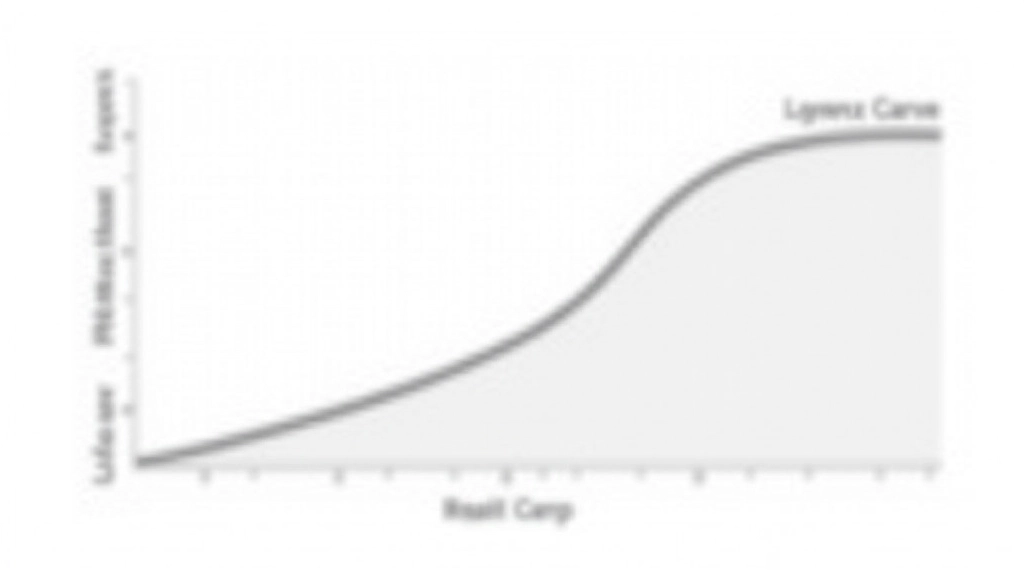
Here’s the fundamental concept: imagine a line graph where the horizontal axis represents the population (from poorest to richest) and the vertical axis represents cumulative income (0% to 100%).

In a perfectly equal society where everyone earned the same, this line would be perfectly diagonal—straight from bottom-left to top-right. But in reality, societies aren’t equal. The actual line curves upward, meaning the richest people hold more than their “fair share” of total income.

The Gini Coefficient measures the area between the diagonal line (perfect equality) and the actual curved line. The bigger that gap, the higher the inequality. It’s that simple—one number capturing the entire story of who earns what.

Lorenz curve diagram showing perfect equality diagonal line and actual income distribution curve with shaded area between them

How to Read the Numbers

The Gini Coefficient runs on a simple scale. Here’s what different numbers actually mean:

0-15

Very Low Inequality

Income is distributed fairly evenly. You’d see this in Nordic countries like Denmark or Sweden where social systems reduce wealth gaps significantly.

15-30

Low to Moderate Inequality

Reasonable income distribution with some gaps. This is where many developed nations sit, including parts of Western Europe.

30-45

Moderate to High Inequality

Clear income gaps emerging. Many middle-income countries fall here, including Malaysia, where the Gini sits around 41-43 depending on the measurement year.

45+

High to Very High Inequality

Significant wealth concentration at the top. You’ll find these numbers in some Latin American and African countries where income distribution is heavily skewed.

What the Gini Coefficient Doesn’t Tell You

Here’s the thing—the Gini Coefficient is incredibly useful, but it’s not perfect. Two countries can have identical Gini scores yet vastly different income situations. A Gini of 35 could represent a wealthy nation where even the poorest people earn decent incomes, or a poorer nation where inequality is lower but everyone’s struggling.

The Gini also doesn’t capture wealth distribution—only income. A country might have fairly even incomes but wildly unequal asset ownership (homes, investments, land). It doesn’t account for regional differences either. Malaysia’s national Gini hides significant variations between urban and rural areas, or between states.

Plus, the Gini can’t tell you why inequality exists. It’s purely descriptive—a measurement tool, not an explanation. You need additional context about taxes, education, employment, and opportunity to understand the actual causes.

Professional economist reviewing income distribution data and inequality metrics at desk with multiple reports

Why This Matters for Malaysia

Malaysia’s Gini Coefficient has hovered around 41-43 in recent years, depending on which household income survey you’re looking at. That’s moderate-to-high inequality. But here’s where context becomes crucial—that single number connects directly to Malaysia’s real economic concerns.

You’ve probably heard about Malaysia’s B40, M40, and T20 classifications. These income brackets exist precisely because policymakers recognized that a single average income figure masks serious inequality. The bottom 40% (B40) earn a fraction of what the top 20% (T20) earn, even though they’re part of the same national economy.

The Gini Coefficient quantifies that concern in a single number—it’s the mathematical proof that Malaysia’s growth hasn’t been evenly distributed. That’s why the government’s Shared Prosperity Vision 2030 exists. It’s designed specifically to reduce Malaysia’s Gini Coefficient by improving opportunities for lower-income groups and ensuring broader participation in economic growth.

Malaysian economic data visualization showing income brackets and wealth distribution patterns across different population segments

Using the Gini Coefficient in Real Analysis

When you encounter Gini numbers in economic reports or news articles, here’s how to interpret them properly:

01

Check the Source and Year

Different surveys (household income surveys, tax records) can produce slightly different Gini numbers. Malaysia’s official statistics come from the Department of Statistics Malaysia (DOSM). Always verify you’re comparing numbers from the same source and year.

02

Look for Trends Over Time

A single Gini number is useful, but what really matters is the direction. Is Malaysia’s Gini going up (inequality worsening) or down (inequality improving)? Comparing year-to-year changes reveals whether policies are actually working.

03

Use It With Other Metrics

Don’t rely on Gini alone. Pair it with income percentile data (like B40/M40/T20), poverty rates, and asset distribution. Together, these paint a complete picture of economic inequality.

04

Consider the Economic Context

Is the Gini changing because incomes at the bottom are rising, or because incomes at the top are growing faster? You need additional context about wage growth, employment, and social mobility to understand what’s really happening.

The Bottom Line

The Gini Coefficient isn’t magic—it’s just a clever way of measuring inequality using one number instead of trying to describe complex income distributions with words. A Gini of 0 means perfect equality (everyone earns the same). A Gini of 100 means complete concentration (one person has all the income). Most real countries fall somewhere in between.

Malaysia’s Gini around 41-43 tells us that income inequality exists, that it’s significant, but that we’re not at extremes. It’s a baseline measurement that policymakers use when designing initiatives like the Shared Prosperity Vision 2030, which aims specifically to reduce that number by broadening economic opportunity and ensuring more equitable income distribution.

The next time you see a Gini Coefficient mentioned, you’ll know exactly what it’s measuring—and more importantly, what it’s not. That’s the foundation for actually understanding economic inequality, rather than just reading a number and assuming you know what it means.

Explore Related Topics

Ready to dig deeper into Malaysia’s income inequality and economic frameworks?

Browse All Articles

Educational Disclaimer

This article is provided for educational and informational purposes only. The Gini Coefficient is one of many tools economists use to measure inequality—it has limitations and doesn’t capture the complete picture of economic well-being. Different data sources and methodologies may produce varying results. For policy decisions, economic analysis, or investment strategies, we recommend consulting official government statistics (such as the Department of Statistics Malaysia), peer-reviewed economic research, and qualified economists or financial advisors who can provide context specific to your circumstances.